Showing posts with label Spain. Show all posts

Tuesday, February 23, 2016

HUELVA & SPAIN are so different 

I have chosen this University, probably from the same reasons that everyone else before me did – nice weather, location close to the beach and the ocean and to improve my knowledge of Spanish. As a student on a Master program, I also didn’t have lot of options, if I am honest. So Huelva was the only logical selection for me (as Master students, you can go to following Universities: University of Split, University of Tartu, Universidade De Lisboa, University of Huelva in Alma Mater Studiorum - Universita di Bologna.) Furthermore, because I already did my first Erasmus in the first cycle in Lisbon (in the year 2013) I know what to expect before the mobility – a lot of paper work, writing emails, communicating, etc. But everything is more than worth it! Also, I have been to South of Spain one year before – me and my family had a road trip from Malaga to Sevilla, so I knew, that life there ... is different. 


And … it was! Spanish … is not Spanish in fact, but Andalus! No one speaks English, nor understands English (the professors at the faculties as well, in general). There is no free Wi-Fi in public places. And did I mention no one understands English? I was lucky, I found my flat before arriving there (you can hire a flat on Huelva Housing, but then you will live just with Erasmus students, so I preferred living with Spanish ones, so I would be forced to practice Spanish and actually learn their culture). I contacted one Spanish girl via the Facebook page (Erasmus Huelva 2015/2016), where lots of people are sharing things ... so, the first month was quite hard. And I didn’t expect that! Because when I did my Erasmus in Lisbon, I felt like home after the first day. And Huelva I must admit felt like home ... after more than one month! But now – I don’t want to leave it! Why? First, definitely because of the language. At the faculty, you can choose English classes ... but in fact, English ... is Spanish English. But everyone is SO nice ... and willing to help. Also, it really depends on the professors, what they demand from you – some classes are obligatory, others are not, normally there were presentations and at the end written exams. But this really depends on the class, you are taking. And the favorite statement of all Andalusian people is: “¡No pasa nada!” So once you will learn this, your life will be easier there! ;)


Another pro is for sure FOOD – tapas, cerveza, vino tinto and tinto de verano. The best ham in the world – jamón Iberico! One of the “must do” things in that area for sure! Usually, we didn’t cook at all, because eating outside is really affordable. And good! A normal meal costed 2-3 EUR (1 tapa and a drink), and when you decide to be more fancy – around 10 EUR, if you go with a friend, and you can try a bunch of tapas and get a good bottle of wine as well. In fact, the living costs are the same or even cheaper than in Slovenia! Eating and drinking outside is definitely cheaper, also more or less all the food in the shops! Rooms are cheap – from 120 EUR up to 200 EUR per month (for a room in a 3-5 bedroom flat). So, with the Erasmus scholarship you can nicely cover your living expenses. To continue with another pro - TRAVELING! From the Seville airport, you can get cheap flights to everywhere - from Morocco, Canarias to Portugal. There are lots of low cost flights from Faro Airport as well! South of Portugal became our second home at the weekends. As well south of Spain. You can easily get to any other bigger city in Spain as well (Madrid, Barcelona), and if you like to surf – Huelva gets another +! 


The only con are public transports. There is a train station and lots of buses, running to and off Huelva. But they are kind of expensive. But you have a lot of other options, like BlablaCar or Amovens. Also some cheap bus companies (like Sociobus), that actually costs less than sharing a car. The easiest was of course having your own car (or have a friend with it). There is a lot of Erasmus students, that drive to Huelva with a car, so if you are sociable and ready for action, you won’t have problems with transportation! Because the city is small, all Erasmus know each other (more or less) so it’s really easy to make new friends and/or travelling companions!


To sum up – I would really recommend Huelva for a place to do your Erasmus. But only, if you like a Spanish way of life (read: “No pasa nada” and slow life) and if you are able to do things alone. And not wait for everything to fall from the tree! At the international office, they are REALLY helpful! But, usually you have to wait like an hour, to get your turn. But that’s how life is in the south of Spain! Don’t go for a coffee, if you only have 20 min. Or in the shop. Or the post office. Everything that you want or need to do takes time! But I found it out really nice, especially when you are comparing the life in Slovenia, where everyone is under stress and in a rush. Spaniards really know how to enjoy life and little things. And how to live every day to the fullest.


Oh! And keep in mind – during the siestas everything is CLOSED. Like everything. Even Chinese shops! So discovering supermarkets, that are open all day long is one of the important things as well, especially if you can’t stand to be hungry!


Urška Planinšek

Malaga, Spain

Port of Malaga from above
Six months ago, Malaga was just a place on the map on the South coast of Spain, particularly in the region of Andalusia and the very much loved country Spain.

Today Malaga is much more than just a place on the map. Malaga is now holding a very special place in my heart. Malaga knows how to make the best “churros” and “bocadillos” in the morning. Malaga knows how to wake you up every morning with the sun in your bedroom and make you the most magical sunsets in the evenings – every day. It also knows how to make you feel happy every single day of your living there and help you create the best memories of your life. It shows you the way of living on the sunny side of the world, with the most amazing people and unforgettable moments.


Now, Malaga is a luggage full of memories that I will never unpack. In fact, it’s impossible to put this experience in words and publish them on the blog. Nevertheless, I’ll try to impress you over Malaga, by giving you a short summary, a few information and photos which I will save forever, to remind me that this experience was real.


“Why did you choose Malaga for Erasmus?”. My answer may be long, but it’s simple. Firstly, – it’s in Spain. Anything to add for? I bet it’s hard to find a person who doesn’t like Spain. Spain is known as a happy country. In fact, it’s proven that Spanish speaking people are the happiest people. It’s a country where the climate is very good through the whole year. Than we have a region of Andalusia. It’s beautiful, diverse and I can assure you, it’s very different from the Spain you have known so far. And finally, why Malaga. It’s the South coast of Spain, where I have never been before. The sun, palm trees and the sea is an every day view. If you love this, you already love Malaga. What else? The language. I wanted to improve my Spanish, which I definitely did. At last but not least, I study tourism. Malaga has strong tourism. I was thinking, if I go there I can be in touch with a city full of tourists and get a different perspective about it. Experience a life living in the city full of tourists. Even the faculty of Tourism in Malaga may have a different approaches to students of tourism. So I took a chance and chose Malaga.

 MALAGA (1. Center Pompidou, 2. Path to the port, 3. The port from above, 4. Malagueta beach)

The University of Malaga is really big. It’s not the university we’re used to. If you have ever wanted to experience the life living in the campus, Malaga is offering that option also. UMA (University of Malaga) is saperated on 2 parts. One is the campus El ejido, which is a little bit older and it’s in the center of the city. You go there by foot. Another, is the Campus Teatinos – where the Faculty of Tourism is. You go there by a bus, but it doesn’t take long. The bus (n. 11) for Teatinos goes every 10 minutes and you get there in 15-20 minutes (depend on the traffic). The Faculty of Tourism is offering many interesting subjects but none of them are in English. If you get lucky, you might have 1 subject offered also in English, but the English spoken by Spanish professors is not understandable. So my advise is, stick to Spanish subjects. Every subject contains practical and theoretical part and usually both are obligatory. Even if they’re not, go anyway. Like that, you can improve your Spanish, pass the exams easier and get to know you schoolmates who are actual inhabitants of Malaga. You might find lecturers difficult to understand, because Spanish language in Malaga in not normal Spanish. It’s called Andalus. They speak fast and do not pronounce the last letters of the words. They are nice but do not expect any privileges from them, just because you’re an Erasmus student. You’re equal to your Spanish schoolmates. Oh, and don’t worry if a professor doesn’t reply on your e-mail right away. You’re in Spain, everything is “con calma”.

The Faculty of Tourism (Teatinos Campus)
When it comes to life and people in Malaga, there are few stereotypes. Everybody is saying that life in Malaga is on the “slow motion button”. It is true. Everything is always “con calma” and “tranquilo”. People there will not stress about being late, or about not getting on the first bus, running down the streets just to get to the store as soon as possible, wake up early and run the errands as the routine is saying. They are waking up around 9-10 a.m., because shops and bars are closed till that hour anyway. Afterwards they have breakfast in some tapas bar, where they usually offer some breakfast sandwiches with natural orange juice and coffee – “bocadillo con zumo de naranja y café”. Only after it, they start their day. Another stereotype I heard about inhabitants of Malaga before I went there was about the Romani people, known as “gitanos”. You will see a lot of “gitanos” on the streets and also people from Marocco. Since Africa is really close, a lot of African people come to Malaga with tobacco and other small things to sell on the streets. What is normal in Malaga and may not be normal for us, is also the thing with toilets. We are all used to ask for the permission to use the toilet in a bar, if we’re not clients. Or we may even have to pay for it. In Malaga, you don’t have to ask for permission. It’s normal that you go in any bar just to use the toilet, even if you’re not the client. And when you’re walking the streets, don’t be surprised if people won’t wait for the green light. If there’s no cars, you can cross the street. The policeman will see you, but won’t say anything to you. I guess they have their own rules about green and red lights. And about the Police, you’ll see them everywhere. They park a car on the walking zones, streets, squares and supervise the crowd 24/7. That makes you feel really safe all the time. You can see them even at 4.30 a.m. when you’re walking home from the party. People in Malaga are very calm, open, loud and know how to live their life. They are very much familiar with siesta and fiesta. They do siesta time every day and they never skip it. You can find them in tapas bars on drinks and tapas every night, not just on the weekends.
Malaga Center –panoramic view


By staying in Malaga, you have a great opportunity to see the whole region of Andalusia. Everything is practically really close. All the cities of Andalusia are not more than 2 hours and a half away from your new home. You can rent a car with friends, split the gasoline costs (both are really cheap), go on organized trips by ESN and MSE or take a BLA BLA CAR and see the most amazing parts of cities nearby. The must on “to see” list is definitely Balcon de Europa in Nerja, Caminito del Rey in El Chorro, Alcazar in Sevilla, Marbella and Puerto Banus, the port of Benalmadena, Alhambra in Granada, The Rock of Gibraltar and their famous monkeys, beaches like Bologna and Tarifa from where you can see the land of Africa and surf. If the finances and time will permit you, do not hesitate to visit some of the destinations like Marroco, Balearic Islands, Madrid, Valencia, Lisbon, Barcelona … The flight tickets are really cheap especially if you’re not confined to a date and the connections from Malaga are really good
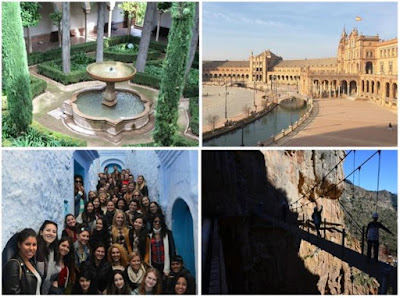
1.Alhambra, Granada; 2.Plaza de España, Sevilla; 3. Marocco, 4. Caminito del Rey

The Rock of Gibraltar

If you’re a foodie, Malaga is once again a perfect choice for you. If you’re not, you’re about to be. Malaguenos really love to spend their time with friends and family by the table. There is always food around them. The seafood there is just amazing. And tapas, you’ll be full of tapas when you get back from the Erasmus. Don’t forget to try as many tapas as possible. Trust me, all of them are good. For example Boquerones en vinaigrette, Chorizo, Croquetas, Ensaladilla, Gabmas al pil pil, Patatas ali-oli, Patatas bravas, Torilla, etc.

1. Gambas al pil pil, 2.Ensaladilla, 3. Croquetas de pollo, 4. Bocadillos

About the normal warm meals you will take, depends on you and your habits. You can cook for yourself, cook with your flatmates or friends or just simply eat outside. If you will decide to eat outside, you can find some really cheap places to eat, but don’t expect some healthy meal or grandma’s style lunch you get served back at home.

Erasmus students mostly live in shared flats with other Erasmus students. The price is mostly around 300€ per month including costs such as electricity, water, internet, etc. You can find your flat and flatmates on different groups on Facebook, where people are posting available apartments, looking for flatmates etc., or you can take a look on the website of Erasmusu.com. A lot of students also come to Malaga without accomodation, stay in the hostel for a few nights and take a look for the flats on their own. It’s your decision. As for the location, I would recommend apartments close to Plaza de la Merced or Calle Victoria. By living there, you will stay in touch with other Erasmus students because most of them are always living there. And also all the night events are organized on Plaza de la Merced.

Plaza de la Merced
The nightlife in Malaga is always ON. As I mentioned before, people from Malaga are very happy, and open. They don’t go out just for the weekends. They go out almost every night. The social life is really important to them. And so is for all the Erasmus students. Mostly all the parties are organized by Erasmusic and the crew itself is awesome. They will make sure you’ll feel welcome and get to know the first friends already on your first night. The prices of the entry and drinks are not an obstacle. During the week the entry price is 3€ or even for free. For the weekends, depends on which club you’re going. The entry on parties with Erasmusic will never cost you more than 5€. If you decide to go out on your own with your own company, it can be around 10€. But never too much. Make sure you always have the ID in your pocket and get ready to have fun!

1. Malaga Panorama, 2. Botellon, 3. Plaza de la Merced, 4. Calle Larios (Christmas time)
Public transport in Malaga is very well organized. There is a connection by buses to all parts of Malaga, and you will never wait for the bus for more than 20 minutes. The university also offers students to get the monthly bus card for 27€. If not, you pay your ride 1.30€ for wherever you go. You can also use a train called Cercanias that takes you all the way to Fuengirola, which is the last stop. The only time I used a taxi was when I needed a ride to the airport. That will cost you around 20€.

The cost of living in Malaga will surely be higher than in Slovenia. Not just that the rent is a little bit higher, but you also see how much you spend on food. When you go to Portorož, you still have your family pretty much close to you. Before you go on the seaside, they fill your car with food, so you don’t even spend so much during the week in Portorož. In Malaga, you’re on your own. Every ingredient you will need, you will have to buy. In my opinion, the cost of living in Portorož and in Malaga can not be compared. Malaga is such a big city (even bigger than Ljubljana) and you always have some things to do there. And with all the activities, there comes the price. The scholarship is definitely not enough for all your costs from the beggining till the end of your Erasmus. But it can cover your accomodation rent which makes everything easier. Some students also find a student job while they’re on Erasmus and as I heard, it’s not hard to find it.

My very last day, when I was driving to the airport, I was thinking what are the pros and cons of my whole Erasmus experience. Honestly, the only negative part is the fact that Erasmus came to an end. You will fall in love with the city, the life on your own, the people you spend your everyday with. That’s why the goodbye is so hard. You see friends leaving, going back home, thousands and thousands of kilometres away. Some of them you will see in the future and some never again. You can return back to visit the city, but it can never be the same.

Erasmus is to learn different languages. Not just the language spoken by the country you have chosen. But also other languages from people you hang out with. Erasmus is to get to know yourself. Either you want it or not, you spend most of the time with yourself, by yourself. You get there on your own, you have to do everything on your own. Everything is up to you. You want to make some new friends? You’ll have to approach them. You don’t understand something in the class? You’ll have to ask. You get lost on your first day in the city? You’ll have to find your way home. You step out of the comfort zone and start to live on your own. Erasmus is people. The people you get to know during your mobility and spend your days with. You will never forget them. Those are the people you make your best memories with. The moments you never forget. They form the best year in your life that can never be repeated. And most of all, Erasmus is an experience. Your life experience. An experience full of good things and very little bad things that you can’t even remember after the mobility. No doubt, Erasmus is something I would recommend to every student. If you have the oportunity, take it. The one who’s not taking it, can only regret it.

And so it is. The end of my ERASMUS. I want to thank all those who have been a part of the best year of my life and make it possible.

HASTA LUEGO MI MALAGA

Maša Brulc

Tuesday, August 18, 2015


¡TOMA LA VIDA CON CALMA, VIVE EN MALAGA¡


We chose to study in Malaga because we wanted to go to Spain to improve our Spanish and because the University of Malaga offered an interesting and diverse study program. Besides of that we decided for Malaga because of the weather - we wanted to have warm/hot weather as much time as possible ;)

La Malagueta district and Malaga's port


Malaga is situated in the center of Andalucia in Costa del Sol. In winter the temperatures do not get lower than 10 degrees and in summer 30 degrees up so from April to October there are many possibilities to go to the beach. Malaga is also a great point to travel around Andalucia and visit nearby cities because of the location we mentioned before. It takes you more or less 2 hours to go to Sevilla by car, 1h 45 min to Cordoba and Granada and 2h 30 min to some amazing beaches like the one in Tarifa or Bolonia beach near Cadiz.

Playa de Bolonia, Province of Cadiz


People in Malaga are relaxed, opened, warm, passionate and they truly know how to enjoy life. They do siesta every day, which is very typical in southern Spain, and their social life is very important to them. They do not miss an occasion to go out for dinner or just beer and tapas with friends or family (bars and restaurants are unimaginably full despite the crisis because for them it is not a waste of money to go out to be with the ones they love).

Malaga's nightlife is lively; there is always something going on. There are a lot of places to spend crazy nights with friends, especially in the city center. Usually young people do botellon (they get together at one's home and have some drinks there), then they go to the bar or straight to a nightclub. The entrance to the nightclub usually costs 5-10 euros and drinks 5-7 euros. There are also a lot of Erasmus parties where you can party only with other Erasmus students. The entrance for that kind of parties is usually lower. Also during the day there are a lot of activities to do, which are organized by different Erasmus organizations. They offer one-day trips, weekend trips, sport activities on the beach, dinners, language workshops, etc.

Erasmus students live in shared flats. Usually you rent a room (the prices are around 250 euros including costs - electricity, water, internet, etc.), in some rare cases landlords rent the whole flat and students must find other students to live with and share the price of the flat.

Public transport in Malaga is well organized. There are buses to all parts of Malaga every 20 minutes. From the center to our university it takes about 20 to 25 minutes. The university offers students the possibility to get the monthly bus card for 27 euros, otherwise one ticket costs 1.30 euros wherever you go. There is also a train called Cercanias that takes you from Malaga to the west (last stop is Fuengirola) and stops at several coastal towns. Last summer also Malaga's metro started to work, but there are still a lot of connections missing, especially the one with the center. To travel around Andalucia you can benefit from BLA BLA CAR (that is similar as our prevozi.org).

UMA (University of Malaga) is divided in two parts. One campus (El Ejido) is situated in the center and the other one in Teatinos. The one in Teatinos is bigger and there is located Faculty of Tourism.


Faculty of Tourism


The faculty offers a lot of different subjects. Professors are kind and they explain everything well, but some of them talk really fast that is why it is recommended to speak and understand Spanish before you go to Malaga. Classes are divided into theory part and practical part. Erasmus students are treated the same as Spanish students that is why you have to study if you want to pass subjects. We heard some stories that you only sign the paper with your name and write beside “Erasmus student” and you pass the exam. In case of Malaga it is not like that, we studied hard and we also learnt a lot about tourism in general and in Andalucia. A good point of studying in Malaga is also that the final grade is composed of different tasks (2 or 3 short tests, group work, individual work and presentations of the group work). If you do not want to get the final grade like that, you can always do the final exam. There is also a cafeteria in the faculty where students can get some snacks to eat, coffee and other drinks, sandwiches and lunch (a meal with first dish or salad, main dish, bread and dessert costs 4.25 euros).

Food in Spain is very delicious. Whenever you come to Spain, even though you do not come to study here, you have to try Spanish food. Usually when we are given the menu in a restaurant, we do not know what to choose ;) Spanish people really know how to prepare tasty food. Some typical dishes are gambas al pilpil, croquetas, patatas bravas, patatas con alioli, paella, tortilla de patatas, gazpacho, salmorejo, etc. Prices in the restaurants are more or less similar than in Slovenia (in touristic places they are a little bit higher, that is why you profit if you go to "restaurantes del barrio" - restaurants there are cheaper, because only local people go there). Prices of food in supermarkets are similar as in Slovenia as well. In Malaga fruit and vegetables are really cheap in markets (not in every stand!).

Typical dish croquetas and gambas al pilpil in the middle


All in all, our experience as Erasmus students in Malaga was great! We got to know so many people from all over the world, improved Spanish a lot, learnt new facts about tourism and visited beautiful places. If we had to decide again where to go to study, we would definitely repeat everything. If you have some more questions, you can write us on Facebook. We thank Malaga and its people for everything and hope to be back again <3

Maša Petek and Martina Poberaj, Erasmus students 2014/15


Huelva – un destello de luz

¡Hola! My name is Nik and I was an Erasmus student in the beautiful city of Huelva. I would like to share my experience with all of you, because I know that is really important to get some information about the destination and experience from someone who has gone through this!

When I was thinking about where to go for my Erasmus mobility … for me there was only one option: SPAIN! Fiesta, siesta, sol, playas … But now when I am thinking about why I have decided exactly for Huelva … I cannot find the answer. I have to admit that before my Erasmus experience I didn’t know that Huelva actually exists … The first time I have heard the name Huelva from a friend of mine, who also did his Erasmus there … and this strange name stayed in my head all the way to the choice of my destination for the mobility. And today I can say that I am really proud of my head that it kept this name inside for so long. :)


University of Huelva (UHU)

The University of Huelva is the only public university in the city. They offer you some courses in English that are intended especially for Erasmus students. The offer of these courses is really limited and most of them are from the area of economics. One thing that I really did not like was that they were changing courses all the time … When you finally find something that can be ok for you … they delete this course or move it to the other semester. But if you speak Spanish, the offer of courses in Spanish is really diverse (for all fields of study). They also offer a really helpful free Spanish course from A1-B2.

Stereotypes, first impression and reality?

I went to Huelva totally open-minded … I had heard some stereotypes about Spanish people, but I am not a big supporter of stereotypes … because first of all I want to get to know this nation and then make my own stereotype/opinion about them. I can say that Spanish people from Huelva are really kind, helpful and generous. They live a really relaxed life, without any hurry or stress. They are really living a “no pasa nada” kind of life. :) But there was one thing that I was a little bit disappointed. I think that every student who goes to the mobility, checks the photos about the destination on the internet before the departure. And when you put Huelva in Google … you get many amazing photos of the beaches. But the reality is different! The photos of the beaches are from Punta Umbria, Mazagon, El Portil … (about 25 minutes by bus from Huelva City), which are small cities close to Huelva City. And many of us were disappointed because, we expected something similar to Portorož … walking to the beach and enjoy after the lectures.


Local culture and habits

“No hablo Inglés, solo español!” is the phrase that you will hear all the time. The level of English is really low, so it’s good if you find someone who speaks Spanish to help you to survive the first days and arrange all the important things. The whole Spain, but especially Andalusia, is a really religious country … almost every month there are some religious celebrations on the streets of the city. In Huelva the two most important ones are “Semana Santa” - holly week, when there are processions during all week (many streets are closed and you need like 1 hour to move for 300 metres) and El Rocio, which is pilgrimage to one small village close to Huelva.

Places and activities

Huelva is the ideal city for travelling … Many famous and beautiful cities are located really close to Huelva. One big advantage is also that the flight tickets from Seville (approx. 1 hour from Huelva) are really cheap. During my mobility I visited Seville, Malaga, Granada, Cordoba, Azores, Morocco, Lisbon and Porto. I would definitely recommend you to visit the Azores in Porto. Ryanair has a new line from Porto to Azores, which is really cheap (approx. 65€ for the return ticket). And the Azores are really a paradise in the middle of the Atlantic. One thing that I will never forget is Colour Run by Desigual and ESN meeting of all Erasmus students from Spain in Seville. It was a really amazing experience, when you feel very proud that you are part of this big Erasmus family. Something that you should not miss is also the Doñana national park, where you can see around 300 different types of birds and endangered Iberian lynx.


Culinary and students meal

Huelva (actually the whole Spain) is known for “tapas”, which are a wide variety of appetizers or snacks. You can order hot or cold “tapas”. I will present you some of them that I really like and I recommend them for trying:

Patatas Bravas (fried or boiled potatoes with a spicy sauce) 


Montaditos (small sandwiches with many different ingredients, the most famous bar for montaditos is called 100 montaditos, where you can order 100 different montaditos – with meat, tuna, goat cheese, kebab chicken … and also the sweet ones with chocolate)


Tortilla de Patatas (potatoes and eggs, but there are also some of them with onion, chorizo, prawns... In Huelva there is a bar called San Jose, where they served officially the best tortilla de Patatas in Spain).


Because of the vicinity of the ocean Huelva is known especially for sea food. The most famous is cuttlefish which is very typical in Huelva, and that is why people from Huelva are also known as Choqueros (Choco is cuttlefish in Spanish).


In Huelva, they don’t have students coupons :) But in the Campus El Carmen they have a big canteen, where you can get a menu for 4,35 € - 2 main dishes/1 main dish and one salad + bread, drink and dessert.

Accommodation
In Huelva, there is one dormitory, but it is more expensive than renting a flat. In my case no one of the Erasmus students lived in the dormitory. All of us were living in flats. I suggest you not to look for the flat before the arrival. There is one company called Housing Huelva that helps you find one. Every day they organize a “room hunting” tour, where they show you free flats, and on this tour you can also meet your future flatmates (like I did). The best way is to book a hostel for 2-3 nights and then go to these tours, and I am 100% sure that you will find flat and flatmates. The price for renting is around is around 180€. 


Night life

The main days to go out are like in Slovenia – Friday and Saturday. But in Huelva there is also the Erasmus party Wednesday, when the ESN team prepares theme parties (on the boat, nerd party, Halloween party …). Usually you go out around 1 a.m. (but before that you are doing/drinking “botellon” in one Erasmus flat). First you go to some pubs and bars (all of them on the same street), where you enjoy the drinks and atmosphere (Mombasa, Lancelot …) and after this you go to one of the two discotheques in Huelva (Ego or Theatre). The prices for chupitos (shots) in pubs are 1 euro and in discotheques are 2 euros. Long drinks are between 3-6 euros. And Spanish people love to drink rum!


Transport

The best way to get around the city is by bike or on foot. Huelva is a small city and everything is pretty much close (except beaches). You can rent a bike for 40€/semester in the Campus El Carmen. If you are lazy, you can use public bus (1 ticket = 1,10 €), but if you buy a ticket for 10 rides, you pay only 0,65€ per ride). To go to the beach you have to take a bus (1,55 € – one way), but you can also go by bike (1 hour) through the beautiful natural park, where you can observe one of the symbols of the city – flamingos!

Costs

Costs are more or less the same as in Portorož. But you have to know that you are there only for a short period of time … So you want to try and experience everything! I won’t lie, but I spent around 800 € per month. Only the scholarship is definitely not enough to cover everything. You should go to Huelva also with your own savings or savings of your family. Mummy? Daddy?


PROS & CONS


J good location for travelling

J low prices/costs

J beautiful beaches


L limited offer of courses in English

L post-erasmus depression


I would like to say that I am really happy that I went to Erasmus in Huelva. This experience is totally unreal, and when you come back home you are thinking all the time about everything that you have seen, experienced … I definitely do not regret that I went to this mobility, because you really grow up like a person … you meet so many amazing people, new cultures, different ways of life. I would like to conclude with one sentence that we were using all the time during the mobility: Erasmus is not a year in your life...is a life in a year!

If you need some advice, some more photos, movies, information about Huelva and Erasmus, please feel free to contact me anytime on my email address (nik.jerovsek@gmail.com) or on my FB profile.

¡Hasta luego, amigos!

Nik Jerovšek

Monday, January 28, 2013

Malaga rules!!!


When I was choosing my area for student exchange, I can say that I had a wish, a wish that came true. I wanted to spend my student exchange in Málaga, Spain. It wasn’t difficult for me, because I have been travelling around Spain and I found a place, a place that felt like home. That was Málaga. Málaga, Ciudad Genial. 

An interesting experience for me was finding my new university. University of Malaga is divided in two parts, or should I say two campuses. Campus el Ejido, that is smaller and campus Teatinos that is bigger than my home town. To get to the campus I have to take a bus and it takes me approximation 20 minutes to arrive. The first day it was confusing because I didn't know my way around but everybody was so nice and wanted to help when I was seeking for information. Finally after walking around for quite some time, I found the international office, where Erasmus students had a meeting. The meeting was very helpful, they explained all the necessary steps concerning the entry and rules regarding their university and also about Spanish culture. I must say that at the beginning of the classes I didn't understand much – the classes are in Spanish and take place at the same with Spanish students. It excited me that the professors are very understanding and try to explain the lectures as many times that is needs so that everybody understands the topic of discussion, even if that means that the professor will have to explain the same thing all over again, but each time on different examples. 

As I have been travelling around Spain and got to know the culture and customs a little bit, so I knew what to expect but I can say that even today I didn't get used to their way of life. Spanish people are an inspiration to me. We all know about the impacts of the crisis in Spain and I can say that I started to feel the pressure of it, but they are very positive and open minded people that will take any excuse to do fiesta and enjoy life with a smile on their face. Spanish people know how to enjoy and live a full life.


If you go to Spain you have to know that when you are in Spain you live by the Spanish rules. Have you ever heard about siesta? Well siesta sounds great, but when you have urgent stuff to do – make copies of important documents or buy stuff that u need in that moment and you get in front of a close market and remember that probably you have to wait an hour or two to get your business done is not so great J. The streets are empty, there is no one around, the streets fell deserted but I have to give it to them that they have respect for their customs and nobody in the world, not even massive tourism is going to prevent them to enjoy their siesta what often means that they are going to take a nap. What I also like about Spanish culture is tapas. And when is the right time to go for tapas? After siesta, before going out to party!


As I was explaining before, one about the many experiences in Spain is going out for tapas. The history of tapas was always very interesting for me. It all started because of flies. Spanish people wanted to prevent that flies were flying into their beer, so they covered the beer with small plates. During time, they started putting small quantities of food on the plates. Pieces of bread, piece of ham, potatoes, meat, basically all types of food. A tapa is a quarter of the normal ration meal and normally u should get a free tapa with beer or a glass of wine but it depends on the place and city where you are going. In Málaga free tapas are normally olives, because they prepare them in a special way and olives are considered a very typical for this part of Andalucía. Málaga is suited in the center of Andalucía as I like to call it. That means that it has a great position when it comes to travelling. It is a good starting point for visit other towns such as: Sevilla, Granada, Cordoba, Gibraltar, Ronda and many more. I love Málaga because it has so many things to offer. Natural parks like Rio Chillar that makes you feel like you are in the middle of the mountains and the best thing about it is that all the time you a walking in a river, so you are walking in water that gets sometimes even over your knees.


Málaga is also known for its gastronomy but people mostly go out for tapas because they are cheap. A tapa with beer is around 1, 50€ - 2, 50€. But in Málaga there is no such thing as student meals so if you want to have a culinary experience you can get one at full price. There are all kinds of restaurants in the city but you have to be careful that you don’t get burned. One of my experiences with Spanish restaurants was that I ordered home-made sausages prepared with a special recipe of the house (this was the English translation in the menu) and got a huge plate with a few slices of salami at a very high price. From that moment on I always consulted the waiter concerning my order. Students often like to go to 100 montaditos where everything you order comes at a price of 1 euro. Also the Sureña is very popular where you can get 5 little beers for 5€ and a special offer two tapas at the price of one. 

Concerning accommodation in Málaga you have to be careful because a lot of people want to exploit young foreign students. A lot of landlords have their own policy. Normally you have to pay a bail of the same amount of money as one month rent. One of them wanted that I pay a double bail and for two months in advance without signing any contract – it has occurred that landlords don’t give the bails back even if everything is all right when the student left the flat. Also you have to pay attention if the landlord gives you a contract for a long time, like 6 months, read it carefully, because it has also occurred that some students because of the circumstances had to leave the flat the landlord kept the bail, because you broke your contract even if you found a replacement – another person to live in the flat. A lot of people lost a one month rent money that way. There are a lot of advertisements all over the city about flats, but the best way to find a flat is joining groups on facebook like Malaga Erasmus, Erasmus flats or visit websites like www.compartopiso.com and go and check the apartment before making any arrangements. Because a lot of times nothing is the way it seems ;-). The prices for rooms go from 200€ - 250€ with or without costs, everything above 250€ is considered expensive.

One thing what you have to know about Málaga is that Málaga is a party city. There are diferent theme parties every day that are organized by different organizations like Erasmusic, Esn, Timetoparty Málaga and others. Even if you decide to go out on your own almost every night there are different parties for different kind of taste. The prices depend where you go and witch day you come. If it is an Erasmus party the prices are low, but normally every drink, it doesn’t matter what you drink comes up to 7€. In Spain I have learned that Slovenian prices for alcohol are very low.


Transport in Málaga is very well organized. There are busses at every 10 – 20 min, you get the monthly ticket for 27€. The train is also a very fast and cheap transport if you would like to visit places nearby Málaga. I don’t recommend it for long trips.

Costs of food and alcohol are almost the same as in Slovenia. Things like meat, cheese, pršut can be very expensive, other things like bread, vegetables and fruit can be very cheap. The scholarship is defenetly not enough if you want to live this lifetime experience and discover the destination that you have choosed.

Spain is really incredible. There is something about it that makes you want to come back. Unfortunately the crisis has its impacts. A lot of Spanish people asked me why didn’t I choose a wealthy country like Germany or Great Britain. I don’t regret my decision and I would do it all over again if I had the chance. I hope that my request that I can continue experiencing this great country will be approved. Because the real fun and real learning about tourism starts in warmer months like March. Did I mention that I had 20 degrees on new years eve? ;-)

The Erasmus experience is the best experience I had in my life and I would recommend it to everybody, because it is an experience and opportunity of a lifetime. Meeting new people, getting to know different countries, different possibilities, different mentalities, new options. This is Erasmus. Don’t miss it!!

"Chicos, si teneís alguna preguntita,póngase en contacto con migo sin ningún duda!!!!"

Katja Darovec
katja.darovec@gmail.com

Wednesday, January 23, 2013

Live and work in Tenerife!


Let us say first that it is definitely not what you would expect. Why? Because we were also surprised when we first came. We imagined it as a tropical island, which it actually is, but it is not its first impression.

When we arrived we were shocked how full of hotels and buildings is south of the island. Even if here is now not top of tourist season, it is still full of tourists, mostly English. If you are not a fan of mass tourism, you will not like that. When you look around the island you see that it is amazing, it is mixture of different people, climates, cultures and lifestyles. Once you leave the south of island behind you realize how people live here. Life is good; here are lots of job opportunities and things to do in your free time. There are places for hiking, beaches where you can swim, surf and dive all year long. All around the year it is warm and on the south it almost never rains. North is colder and not so touristic. As we mentioned before, the south is full of well developed tourism, but still you can find calm places to relax your mind. Here you find people from all over the world who came here for better life, most of them come from rest of Europe, South America and North Africa. People are kind and friendly. We met lots of new friends, for who I am sure we will meet again. 


We also met few Slovenians who live here now. As well our families came to see us and they also liked the island. Because we spend most of our time here at work let us describe also that, because never the less that is why we came here. Work in animation is hard, but once you get used to it, it becomes fun. We work all day with brakes and we have a great team. The more we think of going back home; more scared we are of having boring days, because here we always have something to do. During daytime we organize sport activities for adults or Mini-Club for children and during the night we organize Mini-Disco for children and two shows each night. 


December was quite crazy, but we made it thru without problems. While working here we learned how to communicate with guests and how important public relations are for tourism companies. We also improved our knowledge of English and Spanish and we learned basics of Russian language. It is a bit weird to live in a hotel, but in a good way. We do not cook or clean, we have a great room with balcony and we have a lot of fun.

If we conclude we have to say that we do not regret our decision about coming here, time flies so fast and we are spending it happy here. It will be hard to go back home, but we can always come back here. To all of you who are thinking about doing your practical part of education abroad we recommend Tenerife, you will not regret it. We could write about it for ages, but if you want to know more you just have to experience it by your self!


Masa Mozina & Špela Vavpotič
mozina.masa@gmail.com

Friday, January 18, 2013

University of Girona, Barcelona!


Before I came to Spain and Barcelona, I didn’t know much about this country. Sure, I knew about cities, such as Madrid, Barcelona, Valencia, Las Islas Balearic and a few others, I knew about typical things – flamenco, paella, bullfights, Picasso; but I did not knew much about people, their way of life and the general atmosphere. So when I came here, I learned a little bit every day and I’m still learning it day by day. Mostly I did not know about the greatness of the political problems, the size of unemployment, and mostly, the desire of Catalonians of the separation their region from the rest of the Spain. I heard about it, but I never really understood why they want to be their own country. But now, I’m starting to realize what is the issue and the difference in their way of life and the way of thinking of the Catalonian people. 


The decision about going to Erasmus came out of nowhere actually. I know a lot of people who went studying to other countries and the all had an amazing time. So I started to thinking what if I would go, I went to the meeting we had in school and I started to write the application, not knowing that I will actually send it. But I did, I got accepted, which was frightening and amazing at the same time. So I started to preparing myself, I wasn't sure till the last few days if I will actually go, but I did and here I am. I got my flat over some other girl from our university who was in Barcelona last semester. She met this girl who rented apartments there and she gave me her contact. We talked over email and that was it. I got pretty lucky with the whole apartment thing, but they have a lot of student renting web pages, so it’s not hard to find the place to live. Your own rooms cost from 250- 400 euro per month. Some rooms have expenses included, some not. So you have to take time to find the apartments you like, write to owners, ask a lot of questions, be persistent, and it’s better to go to some hostel for a few days and you visit apartments in person before you sign or pay for anything. Because you can come across with some pretty strange people or the flats.

The catch here, is the money. The scholarship we get isn’t nearly enough, so you need to have your own money. We got 80% of the scholarship before we came, and the rest after we come back. Plus another scholarship that we get ( I think) in June, which for me, since I am in Spain the first semester, doesn’t help a lot. So save the money, save it a lot, because you will really need it.
But general as I see people of Spain are passionate, loud, friendly and very welcoming. I was surprised how people that I came across with, were trying to make a contact with me. Even though not many people can speak English, they still put a great amount of effort of including me in the conversation and their lives, even though I am just a stranger to them. I felt accepted right away. In my college this semester are only a few Erasmus students, I heard it is better to come here the second semester; so I don’t know many people from my school. But the kids there are still very friendly, just no one speaks English, not even the teachers, which I find pretty strange. The classes are all in Spanish, one of the professor is also having trouble with Spanish, she speaks a lot in Catalan. Also the whole organization in this school is a little bit weird. They don’t tell you anything, you have to ask all the time about some activities, days free of classes, even the lectures aren't on-line. You have to follow the classes which can be pretty hard sometimes because professors speak fast and if you don’t understand everything in Spanish, can be pretty tricky. If you don’t know the language, I think it is very hard to stay here. So I recommend some classes before you arrive.
About activities, I can say Barcelona has a lot to offer. Just walking true the centre you find street singers, shows, lots of tourist and just the atmosphere is charming. Walking on the beach, over the full La Rambla, the Passeig de Gracia or visiting one of the many tourist attractions or parks is an amazing experience. If you some of the Facebook pages such as ERASMUS Barcelona and many other you get invitations to parties, activities every day. There is a lot to do in this city, you just have to get involved, be willing to meet new people and try new things,. There are organized trips to Madrid, Girona, Valencia and some other cities so you experience even the Spain outside of Catalonia.
The night life is amazing here. There are parties every day, over the Facebook you get invitation, you send your name for the entrance list and you most of the time have it for free. Usually the free entrance is until 2 or 2.30 am, they start their party life very late. Spanish people have their dinner at 9 or 9.30 pm, so they start to drink at around 11 so they enter clubs pretty late. For us it is a bit weird so u have to have a lot of energy to make it thru the morning. In usual Erasmus clubs music if RNB, commercial, Mtv style, and it is the same almost in every place and every time. I found this party club El row 14, which is near the airport, the music is better, it is named one of the best clubs in the world. I really enjoyed it there, but the parties are usually at Sundays from 17h – 3 or 5 am. The prices in clubs are around 10 to 14 euros, but when you pay the entrance, you have the commission for one free drink! I didn’t know that at first so it is a good thing to keep the ticket so you cash it in the bar.

The food here is pretty much “normal”. They have a few specialities such as patata, I really like it, it’s is a potatoes with eggs made into some kind of pie. Paella, I haven’t tried it because it is made of sea food and I don’t eat sea food. There are some new and different things and food, and some are missing. I really miss here “Radenska”, “čokolino”, “cedevita”, “vegeta” and some other food.
The prices here are pretty much the same. There are stores such as Eroski and Dia, who has their own products and they are cheaper, but some other are more expensive. The general life is more expensive, since they have bigger salaries.
transport here is good, there is metro, they drive pretty fluent, every 2, 3minutes; there is bus, which is not so often as metro and it takes you a while to get to other part of the city because of the traffic, then there are trams, I actually never travelled with those; and of course taxis, which can be pretty expensive if they realize you are a tourist. So I recommend metro, even though there is a lot of people there no matter the day or the hours, it is always full, which in the night can be a good thing, and it makes you feel more safe. The prices are 50 euros for one month, or you can buy a card for 10 journeys, for 50 journeys in 30 days.. different options but it is relatively expensive. The prices are available at www.tmb.cat.

Closuring I would have to say that I am very happy to go thru this whole experience. I sure do miss my family, friend and my life but it actually gave me a chance to focus on myself, my life wishes, I learned a lot about myself, what i like, what I don’t, what kind of a person am I, so it was worth it. I think even if you are thinking about going it, you should. It is kind of expensive, but it is worth it. You definitely get more independence, you come across with new situations, people and you learn a lot of new things.

Nika požun
nikapikapozun@hotmail.com


Wednesday, December 19, 2012

AMAZING HUELVA!


So, my Erasmus experience started in September 2012, when I left my home town and went to Huelva. Since I was at University I knew that I want to have my own Erasmus experience  but wasn't sure where I want to go. As soon as I started learning Spanish  choosing Spain was an obvious choice for me. Huelva was than recommended to me by my school mate and I can truly say that this was really a good decision.


University and lectures

In Huelva they have to different schools that are under the umbrella of University of Huelva: Campus el Carmen and La Merced.

As Erasmus student you can choose if you want to take courses in English or in Spanish. They offer around 40 different courses in English, but of course just a few are from the field of tourism, but if your Spanish is good enough you are most welcome to take courses that are thought in Spanish language.

Since I'm only taking lectures in English I can only tell you, that teachers speak English quite well and that they are really nice. The only problem that I can see here is that maybe not everyone can find curses that are compatible at their home University.

Huelva

I came to Huelva really open minded with no expectations, because I knew that if I had high hopes, there was a chance that I might be disappointed  At first there was quite a cultural shock for me, but went away in a week or so. I wasn't ready for everything to be so slow, everyone to be so nice and helpful, but the biggest shock was siesta. During that time no one is outside, the city literally looks like no one lives there :). But believe me, after a while siesta becomes your best friend. 


Plaza De Las Monjas – city center

What I really find interesting is the time table of the shops, just because usually there is none. Supermarkets work from 9.15 – 21.15 and they don't have siesta, but some shops with clothes and food do have it. They don't have time tables written down on the windows of the shops, so you just have to figure it out by your self.

Otherwise, the city center is really nice and I like it a lot.

Accommodation

There is no student dorms in Huelva, so you will have to rent an apartment. I pay 166 € per month + additional costs (water, electricity). Our landlord is paying for the internet. I found my room with help from facebook – I joined two groups: Erasmus Huelva 2012 – 2013 and Esn Huelva and found all the answers there. If you still need some help you can go to International office, which is located in Campus el Carmen and they will help you find a place to stay.

Food

Prices for food in supermarkets are pretty much the same as in Slovenia, alcohol is cheaper than at home.
Usually people like to go for tapas, which are a great way of trying the local food. I can't recommend any student meals, because we cooked a lot at home.


Tapas

Activities

One of the best ways to travel and meet some of the Erasmus students (there are around 500 per semester) is to do it with ESN Huelva (Erasmus student network). They organize one day trips and some longer ones as well. I went with them to Cordoba & Granada for tree days and it cost me only 85 € and it was the same for Lisbon trip.

They also organize Erasmus parties every Wednesday, so you definitely won't be bored.

Party

Some good places to go:
· cheep drinks: Mombasa, 100 chupitos
· Spanish music: Buddha (during the weekend there is a lot of local people) – you have to have some kind of ID, but they let you in with ESN card as well
· other places that I like: Ego, New York, Moulin Rouge


 Where are you from party

Public transport

The best way to get around is with bus. Their local bus company is called Emtusa and one way ticket is 0,90 €. The city is really not that big, so if you live somewhere near the center, you really don't need to use the bus. If you want to get to the beach (Punta Umbria, Mazagon ect.) you can use the Damas buses.

Comparison with Portorož

Lets compare costs for living first. Rent and costs for food are pretty much the same as in Portorož. The only thing where you can spent a lot of money is on alcohol (of course it depends on how much and how often you party and drink), on tapas or just eating out and for travelling.

If I'm honest scholarship only, won't be enough for getting through the month. If you decide not to travel at all and not to try anything new there, then you won't need a lot more, but Huelva is a really good place to travel from (a lot of interesting places and countries to see are close), so not taking the advantage of that would be really stupid.

Cons

The only con for me is not the best selection of courses in English, otherwise I can't think of anything bad at all.

Pros

There is a lot of them, starting with meeting the biggest amount of great people. We are now one big Erasmus family and everyone is really nice.

The next one is learning or improving Spanish and also learning new and interesting things at lectures.
Then is trying new food, travelling, good parties, going to the beach, ect..


So, all in all, I would say that choosing Huelva for Erasmus experience was a great decision. I don't regret it at all and I would do it all over again.

If you have any questions, don't hesitate and just sand me an e-mail on tami_14.4@hotmail.com.

Hasta luego,

Tamara Ratej :)
tami_14.4@hotmail.com